
Sectigo Blog
7 different types of SSL certificates explained
Learn about the different types of SSL certificates: Extended Validated (EV), Organization Validated (OV) and Domain Validated (DV). Each type offers a unique level of security, verification depth, and purpose. Learn how they work, how they differ, and which option is best for your website.
Table of contents

SSL (Secure Sockets Layer) / TLS (Transport Layer Security) certificates are used to authenticate the identity of a website and create a secure, encrypted connection between the web server and a user’s web browser. They protect sensitive data, such as login credentials, payment information, and other personal details, from being intercepted by hackers.
When HTTPS appears in the URL of a browser like Chrome, it confirms that an SSL certificate is active and the connection is secure. SSL certificates use a pair of cryptographic keys, a public key and a private key, to encrypt and decrypt information, keeping data confidential while it travels between the browser and server.
Depending on your needs, there are many different types of SSL certificates, each with unique validation processes and use cases. The level of authentication provided by a Certificate Authority (CA) is a significant differentiator between the types. Each type of certificate requires specific information and documentation, and once that is received, a CA follows a set of Baseline Requirements to complete the certificate verification process before issuance.
There are three main SSL certificate types, categorized by their validation level:
- Extended Validation (EV): offers the highest trust and most thorough identity verification.
- Organization Validation (OV): confirms both domain ownership and the organization’s legal identity.
- Domain Validation (DV): verifies control of a domain name only, providing a basic level of authentication.
In addition to these validation levels, there are different variations of SSL certificates based on how many domains they cover:
- Single Domain: secures one fully qualified domain name.
- Multi-Domain (MD), also known as Subject Alternative Names (SAN): secures multiple domains under one certificate.
- Wildcard: secures a single domain and all of its subdomains.
- Unified Communications (UCC): designed for Microsoft Exchange and Office Communication Server environments.
When determining which type of SSL is needed for a website, enterprises and individuals should start by choosing the main authentication type that adheres to their website security requirements. From there, they can opt for a specific package to meet the unique needs of their domain setup. Certain variations are better suited for businesses with a single domain vs multiple domains vs a single domain with several subdomains.
For example, a small non-eCommerce business may only need a Single Domain DV certificate, while a larger organization managing multiple websites may require a Multi-Domain EV SSL.
Learn about each type below to find the most appropriate, cost-effective option for your needs.
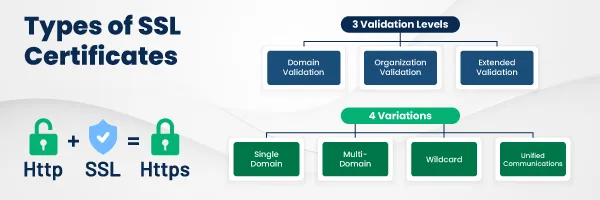
SSL certificate authentication types
The functionality of your website and how it’s being used will help determine the level of validation needed for your certificate. Different validation levels provide varying degrees of trust and protection for site visitors.
Domain validation SSL certificates
Domain Validation (DV) SSL certificates, also known as domain validated certificates, provide the quickest, easiest, and most affordable way to obtain industry-standard encryption. This type of certificate verifies only that the applicant controls the domain name being secured.
DV certificates are typically issued within minutes, since no additional business documentation is required. Once installed, they display the HTTPS prefix before the domain name and trust indicators like the tune icon in Chrome.
Benefits of a DV SSL certificate:
- Validates control of a domain.
- Enables HTTPS and visible trust indicators in browsers, reassuring visitors that their connection is encrypted.
- Issues within minutes.
- Cost-effective solution for smaller websites, offering encryption without the need for complex business validation.
DV SSL Use cases
Since the legitimacy of the organization is not verified, DV SSL certificates work best on websites that don’t collect any personal data or credit card transactions. Common use cases include blogs, portfolios, small informational sites, internal systems, and testing environments.
They provide baseline encryption and authentication, suitable for low-risk sites needing a secure connection without extensive validation.
Organization validation SSL certificates
Organization Validation (OV) SSL certificates are a step up from DV in terms of authentication and trust. To receive one, an organization must prove domain ownership and verify that it is a legally registered business. During this process, details such as the organization’s name, address, phone number, and registration status are confirmed by the Certificate Authority (CA).
This extra verification gives visitors confidence that the website is operated by a legitimate company, not an anonymous entity.
Benefits of an OV SSL certificate:
- Validates both domain ownership and the organization’s business identity.
- Displays HTTPS and trust indicators in major browsers.
- Shows verified organization details in the certificate information, allowing users to confirm who operates the website.
- Issued within 1–3 business days once documentation is reviewed, balancing stronger validation with quick turnaround time.
OV SSL Use cases
Since OV SSL certificates can only be issued to a registered organization and not individuals, this makes them more suitable for commercial and public-facing websites.
They are still not ideal for sites collecting highly sensitive information, but they are a strong option for businesses, nonprofits, and organizations looking to demonstrate authenticity and build trust online.
Extended validation SSL certificates
Extended Validation (EV) SSL certificates provide the highest level of trust and authentication available, and are the industry standard for eCommerce and enterprise websites. To receive one, website owners must meet the authentication requirements for an OV SSL but also complete a more detailed, manual vetting process performed by a human specialist.
This human verification step provides an added layer of assurance, confirming not only that the business is legitimate but also that the requester is authorized to obtain the certificate on behalf of the organization. This thorough review builds customer confidence, especially when handling online transactions or sensitive data.
EV certificates provide the same trust indicators as DV and OV certificates, but the rigorous validation process makes them significantly harder for phishing or fraudulent websites to imitate. For users, this signals that the website’s identity has been fully verified and is safe to interact with.
Benefits of an EV SSL certificate:
- Validates domain ownership and verifies the legal identity of the organization.
- Displays HTTPS and trust indicators in browsers.
- Authenticates the legitimacy of an organization, adding an additional level of trust.
- Verifies the applicant has the right to request an EV SSL and is in good standing with the organization.
- Displays verified organization details within the certificate information, which users can inspect to confirm legitimacy.
- Offers the strongest protection against phishing attacks, making it difficult for malicious actors to impersonate the site.
- Issues in 1-5 days after all required documents are received.
EV SSL Use cases
EV SSL certificates are recommended for all business and enterprise websites but are especially important for any site that requests personal information from users (eCommerce, financial, legal and otherwise). They are ideal for organizations seeking maximum user trust and protection against impersonation or fraudulent activity.
Other SSL certificate variations
Today's websites have multiple layers of pages, domains, and subdomains. Whether you need to secure a single domain with one subdomain, or 100 domains and their aligning subdomains, there are different SSL variations designed to match your setup. These options make it easier for businesses of any size to maintain strong encryption and efficient certificate management.
Single domain SSL certificates
A single domain SSL secures one fully qualified domain name, including both the WWW and non-WWW versions. It can also secure a single subdomain, hostname, IP address, or mail server.
This variation is available in DV, OV, and EV authentication options, making it flexible for different trust levels.
Benefits include:
- Simplifies certificate management by focusing encryption on one domain, reducing cost and renewal complexity.
Ideal for: Business or personal websites that only use one primary domain, landing pages or blogs that do not require multi-domain coverage, or small organizations seeking affordable protection for one main site.
Multi-Domain (MD) or Subject Alternative Names (SAN) SSL certificates
Also commonly referred to as SAN certificates, multi-domain certificates allow a single certificate to secure multiple domainsor subdomains, whether they share the same root domain or belong to different websites entirely.
One SAN certificate can secure up to 250 unique domains, providing a centralized solution for complex organizations or enterprises with multiple brands or services.
Benefits include:
- Protects multiple domains with one certificate, reducing administrative burden.
- Supports a mix of subdomains and unrelated domains, such as example.com, example.org, and store.example.net.
- Available in DV, OV, and EV validation levels to meet varied compliance or security needs.
- Simplifies renewals and management by consolidating everything under one certificate.
Ideal for: Hosting providers, corporations with multiple brand websites, or IT teams managing extensive domain portfolios.
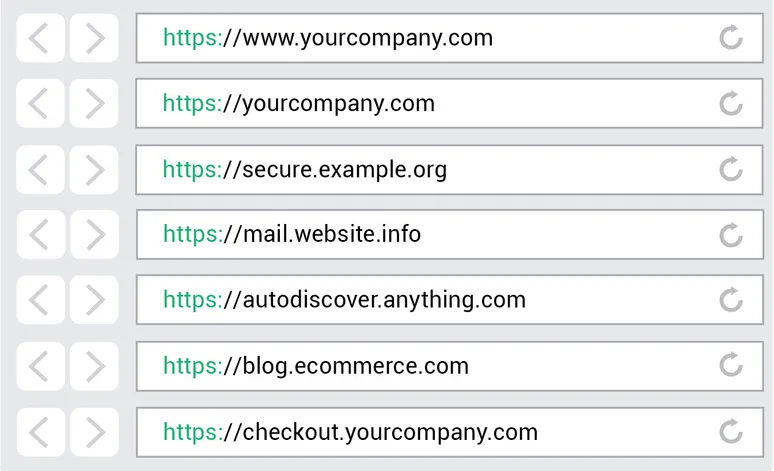
Multi-Domain SSL Certificates Secure Multiple Domains
Wildcard SSL certificates
A Wildcard SSL certificate is used to secure the main domain and an unlimited number of subdomains under the main domain. For example, www.yourwebsite.com, login.yourwebsite.com, and mail.yourwebsite.com would all be secured with one Wildcard certificate.
Benefits include:
- Available in DV and OV validation options.
- Provides strong encryption for all subdomains without the need for separate certificates.
- Easily scalable, so new subdomains are automatically secured when created.
Ideal for: Organizations managing multiple subdomains under one main domain, such as SaaS platforms or eCommerce sites.
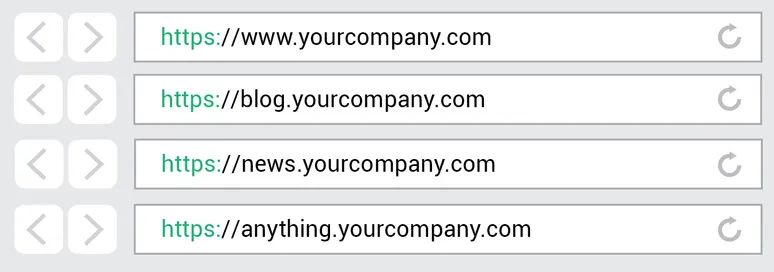
Wildcard SSL Certificates Secure the Main Domain & Unlimited Sub-Domains
Unified communications (UCC) SSL certificates
The Unified Communications certificate type is designed for the Microsoft Exchange and Microsoft Office Communication Server environments. This is a multi-domain option that can secure up to 100 domains at once.
Benefits include:
- Simplifies security management for email, collaboration, and VoIP systems.
- Reduces cost and configuration time compared to managing individual certificates.
- Supports SAN fields, allowing customization for specific Exchange environments.
Ideal for: Businesses using Microsoft Exchange, Teams, or other unified communication platforms that require secure, encrypted connections across multiple services.
Trust Sectigo as your SSL certificate provider
Sectigo is one of the world’s leading Certificate Authorities and the #1 provider of SSL certificates trusted by millions of websites. With a full range of validation options including Domain, Organization, and Extended Validation, Sectigo helps businesses of every size protect data, build trust, and comply with modern security standards.
See a comparison of our different types of SSL authentication levels and variations here, and if you need more information on choosing the right one for your website, contact Sectigo today.